

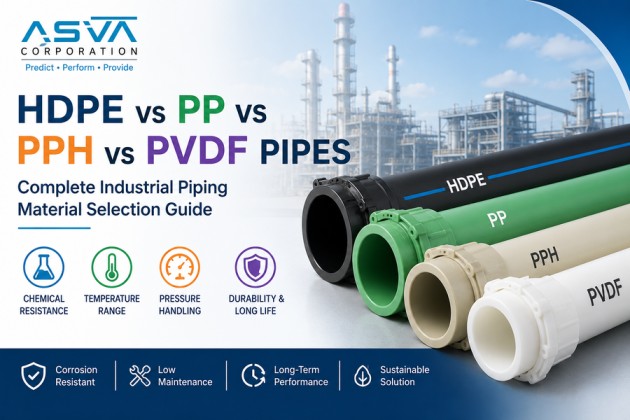
Selecting the right piping material is one of the most critical decisions in any industrial project. Whether you are designing a chemical processing plant, water treatment facility, pharmaceutical manufacturing unit, semiconductor plant, or industrial utility system, the performance and reliability of the piping network directly affect operational efficiency, maintenance costs, and long-term profitability.
Among the most widely used thermoplastic piping materials, HDPE, PP, PPH, and PVDF have emerged as preferred choices due to their corrosion resistance, lightweight construction, durability, and cost-effectiveness.
However, many engineers, consultants, procurement managers, and project owners struggle to determine which material best suits their application. Each material offers unique advantages depending on the operating conditions, chemical exposure, temperature requirements, and budget.
In this comprehensive guide, we compare HDPE, PP, PPH, and PVDF pipes based on chemical resistance, temperature tolerance, pressure capabilities, installation methods, costs, and industrial applications to help you make an informed decision.
Understanding HDPE Pipes
HDPE (High-Density Polyethene) pipes are among the most commonly used piping systems across industrial and infrastructure projects worldwide.
Manufactured from high-density polyethene resin, HDPE pipes are known for their flexibility, impact resistance, leak-free joints, and excellent corrosion resistance.
Key Features of HDPE Pipes
- Lightweight and easy to install
- Excellent impact resistance
- High flexibility
- UV-resistant options available
- Corrosion-free performance
- Long service life exceeding 50 years
- Suitable for underground installations
- Leak-free fusion welding technology
Common Applications
- Water distribution systems
- Irrigation networks
- Wastewater treatment plants
- Industrial water supply systems
- Mining operations
- Gas distribution systems
- Infrastructure projects
Advantages
- Cost-effective solution
- Durable and flexible
- Low maintenance requirements
- Excellent impact resistance
- Leak-proof joints
Limitations
- Limited temperature resistance
- Not ideal for highly concentrated aggressive chemicals
- Lower mechanical strength compared to PVDF
Understanding PP Pipes
PP (Polypropylene) pipes are widely used in industrial applications requiring chemical resistance and moderate temperature handling.
Polypropylene offers excellent resistance to acids, alkalis, and salts, making it suitable for many industrial processing systems.
Key Features
- Good chemical resistance
- Lightweight construction
- Smooth internal surface
- Low friction losses
- Cost-effective industrial solution
- Good thermal insulation properties
Common Applications
- Chemical processing plants
- Industrial drainage systems
- Laboratory piping
- Water treatment facilities
- Food processing units
Advantages
- Affordable and economical
- Resistant to many industrial chemicals
- Easy to fabricate and install
- Low maintenance
Limitations
- Lower impact strength at low temperatures
- Less durable than PPH in demanding industrial environments
Understanding PPH Pipes
PPH (Polypropylene Homopolymer) is an advanced form of polypropylene designed specifically for industrial applications requiring higher mechanical strength and superior chemical resistance.
Compared to standard PP, PPH offers improved rigidity and better performance in aggressive chemical environments.
Key Features
- High stiffness and rigidity
- Excellent chemical resistance
- Better pressure handling capabilities
- Long operational life
- High structural stability
- Suitable for demanding industrial processes
Common Applications
- Acid transfer systems
- Chemical manufacturing plants
- Electroplating facilities
- Industrial exhaust systems
- Corrosive fluid transportation
- Chemical storage systems
Advantages
- Higher strength than PP
- Better dimensional stability
- Superior chemical resistance
- Excellent long-term performance
Limitations
- Higher cost than standard PP
- Less flexible than HDPE
Understanding PVDF Pipes
PVDF (Polyvinylidene Fluoride) represents one of the most advanced thermoplastic piping materials available today.
It is widely used in industries where exceptional chemical resistance, purity, and temperature performance are required.
PVDF pipes can withstand aggressive chemicals, high temperatures, and demanding process conditions that would damage many other piping materials.
Key Features
- Outstanding chemical resistance
- High-temperature capability
- Excellent purity levels
- UV resistance
- Fire-resistant properties
- Long-term reliability
- Superior mechanical performance
Common Applications
- Pharmaceutical manufacturing
- Semiconductor production
- Chemical processing industries
- Ultra-pure water systems
- Biotechnology facilities
- High-purity industrial applications
Advantages
- Exceptional chemical resistance
- High-temperature performance
- Long service life
- Minimal contamination risk
- Excellent weather resistance
Limitations
- Higher initial investment
- Requires specialised installation expertise
HDPE vs PP vs PPH vs PVDF Pipes: Detailed Comparison
| Feature | HDPE | PP | PPH | PVDF |
|---|---|---|---|---|
| Chemical Resistance | Good | Very Good | Excellent | Outstanding |
| Temperature Resistance | Up to 60°C | Up to 90°C | Up to 100°C | Up to 140°C |
| Impact Strength | Excellent | Good | Very Good | Excellent |
| Pressure Handling | Good | Good | Excellent | Excellent |
| UV Resistance | Good | Moderate | Moderate | Excellent |
| Purity Level | Moderate | Good | Good | Exceptional |
| Cost | Low | Low-Medium | Medium | High |
| Service Life | 50+ Years | 25-40 Years | 40+ Years | 50+ Years |
Chemical Resistance Comparison
When handling aggressive chemicals, material selection becomes critical to ensuring plant safety and operational efficiency.
HDPE
Suitable for:
- Water treatment chemicals
- Mild acids
- Alkalis
- Industrial wastewater
PP
Suitable for:
- Acids
- Salts
- Alkaline solutions
- Industrial process fluids
PPH
Ideal for:
- Concentrated acids
- Corrosive industrial fluids
- Chemical manufacturing processes
- Electroplating chemicals
PVDF
Best choice for:
- Sulfuric acid
- Hydrochloric acid
- Nitric acid
- Ultra-pure chemicals
- Semiconductor-grade applications
Winner: PVDF
Temperature Resistance Comparison
Industrial processes often involve elevated temperatures that can affect piping performance.
HDPE
Operating range: -40°C to 60°C
PP
Operating range: Up to 90°C
PPH
Operating range: Up to 100°C
PVDF
Operating range: Up to 140°C
Winner: PVDF
Pressure Handling Comparison
Pressure capability is another important factor when selecting industrial piping systems.
HDPE
Offers good pressure resistance and flexibility for water and utility applications.
PP
Suitable for moderate pressure applications.
PPH
Provides enhanced strength and superior pressure performance.
PVDF
Excellent pressure resistance even in demanding industrial environments.
Winner: PPH and PVDF
Cost Comparison
Budget considerations play a major role in piping system selection.
HDPE
Most economical option for large-scale projects.
PP
Slightly higher than HDPE while offering better chemical resistance.
PPH
Moderate investment with enhanced industrial performance.
PVDF
Premium solution designed for critical applications.
Cost Ranking
- HDPE (Lowest Cost)
- PP
- PPH
- PVDF (Highest Cost)
Winner for Budget Projects: HDPE
Winner for High-Performance Applications: PVDF
Which Pipe Material Should You Choose?
Choose HDPE If:
- You need a cost-effective solution
- Water transport is the primary application
- Underground installation is required
- Flexibility is important
Choose PP If:
- Moderate chemical resistance is sufficient
- Budget is a key consideration
- Medium-temperature processes are involved
Choose PPH If:
- Chemical resistance is critical
- Higher mechanical strength is required
- Industrial process reliability is important
- Corrosive fluids are involved
Choose PVDF If:
- Aggressive chemicals are involved
- High temperatures are expected
- Ultra-pure processes are required
- Long-term performance is the priority
Industries Using HDPE, PP, PPH, and PVDF Pipes
Chemical Processing Industry
Preferred materials: PPH and PVDF
Pharmaceutical Industry
Preferred material: PVDF
Water Treatment Plants
Preferred material: HDPE
Mining Industry
Preferred material: HDPE
Semiconductor Manufacturing
Preferred material: PVDF
Electroplating Industry
Preferred material: PPH
Food & Beverage Industry
Preferred material: PP and PVDF
Infrastructure Projects
Preferred material: HDPE
Future of Industrial Thermoplastic Piping Systems
As industries continue to focus on sustainability, corrosion resistance, and operational efficiency, demand for thermoplastic piping systems is growing rapidly.
Advanced materials such as PPH and PVDF are increasingly replacing traditional metal piping systems due to their superior chemical resistance, reduced maintenance requirements, and longer service life.
Organisations investing in modern industrial infrastructure are increasingly selecting engineered plastic piping systems to improve plant reliability while reducing lifecycle costs.
With increasing investments in chemical processing, water treatment, pharmaceuticals, and semiconductor manufacturing, demand for high-performance piping materials is expected to grow significantly in the coming years.
Why Choose Asva Corporation for Industrial Piping Solutions?
Selecting the right piping material is only the first step toward building a reliable and long-lasting industrial piping system. Equally important is partnering with an experienced manufacturer that understands the technical requirements of your industry and can deliver consistent product quality.
Asva Corporation is a leading manufacturer and supplier of industrial thermoplastic piping systems, serving clients across India and international markets. With extensive expertise in corrosion-resistant piping solutions, the company provides high-quality products designed to meet the demanding requirements of various industries.
Our Product Range
- HDPE Pipes & Fittings
- PP Pipes & Fittings
- PPH Pipes & Fittings
- PPR Pipes & Fittings
- PVDF Pipes & Fittings
- HDPE Electrofusion Fittings
- Industrial Control Valves
- Engineering Products
- Laboratory Sinks and Accessories
Industries We Serve
- Chemical Processing
- Water & Wastewater Treatment
- Pharmaceuticals
- Electroplating
- Mining
- Food & Beverage
- Infrastructure Projects
- Industrial Manufacturing
Contact Asva Corporation
If you are planning a new industrial project or looking to upgrade your existing piping infrastructure, Asva Corporation‘s technical experts can help you select the most suitable material based on:
- Chemical Compatibility
- Operating Temperature
- Pressure Requirements
- Installation Environment
- Project Budget
- Long-Term Performance Goals
Website: https://acindia.in
Email: in**@*****ia.in
Our team is committed to providing reliable, durable, and cost-effective industrial piping solutions tailored to your application requirements.
Conclusion
There is no single piping material that fits every industrial application. The ideal choice depends on your operating conditions, chemical exposure, temperature requirements, pressure demands, and budget.
HDPE remains the preferred solution for water transportation and infrastructure projects due to its affordability and flexibility. PP offers reliable chemical resistance for general industrial applications. PPH provides enhanced strength and durability for demanding chemical environments. PVDF stands out as the premium solution for highly corrosive and high-temperature applications where performance cannot be compromised.
By carefully evaluating process requirements and partnering with a trusted supplier like Asva Corporation, businesses can improve system performance, reduce maintenance costs, and maximise long-term operational reliability.
Frequently Asked Questions (FAQs)
1. What is the difference between HDPE and PVDF pipes?
HDPE pipes are cost-effective and ideal for water applications, while PVDF pipes offer superior chemical resistance and high-temperature performance for critical industrial processes.
2. Which pipe material is best for chemical industries?
PPH and PVDF pipes are generally preferred for chemical processing due to their excellent resistance to aggressive chemicals.
3. Are PPH pipes better than PP pipes?
PPH pipes offer higher mechanical strength, improved rigidity, and better performance in industrial environments compared to standard PP pipes.
4. Can HDPE pipes be used for acid transfer?
HDPE pipes can handle certain acids and chemicals, but PPH or PVDF may be more suitable for highly concentrated corrosive substances.
5. Why are PVDF pipes used in pharmaceutical plants?
PVDF provides exceptional purity, chemical resistance, and contamination-free performance required in pharmaceutical manufacturing.
6. What is the lifespan of HDPE pipes?
Properly installed HDPE piping systems can last more than 50 years under normal operating conditions.
7. Which piping material offers the best temperature resistance?
PVDF pipes offer the highest temperature resistance among these materials, handling temperatures up to approximately 140°C.
8. Are thermoplastic pipes better than metal pipes?
In many industrial applications, thermoplastic pipes provide superior corrosion resistance, lower maintenance costs, and longer service life than conventional metal piping systems.
9. Which pipe is best for sulfuric acid applications?
PVDF pipes are often recommended for highly corrosive acids such as sulfuric acid due to their exceptional chemical resistance.
10. How do I choose the right industrial piping material?
The right material depends on factors such as chemical compatibility, temperature, pressure, installation environment, and project budget. Consulting an experienced manufacturer like Asva Corporation can help ensure the best selection.
